Bridgy Fed Turns an RSS Feed Into a Fediverse and Bluesky Account, and What the Feed Needs
A plain RSS feed is enough to give a website its own account on Mastodon and Bluesky. No plugin, no server of your own, no second account to post from. Bridgy Fed, the bridge run by the nonprofit A New Social, reads the feed, turns each new item into a post on both networks, and sends replies and likes back to the site.
That makes it the obvious route for static sites, Hugo blogs and custom builds that can't run a fediverse plugin. It also means the quality of your feed decides how your posts look on the other side. Here's what the bridge actually reads, and the feed details that trip people up.
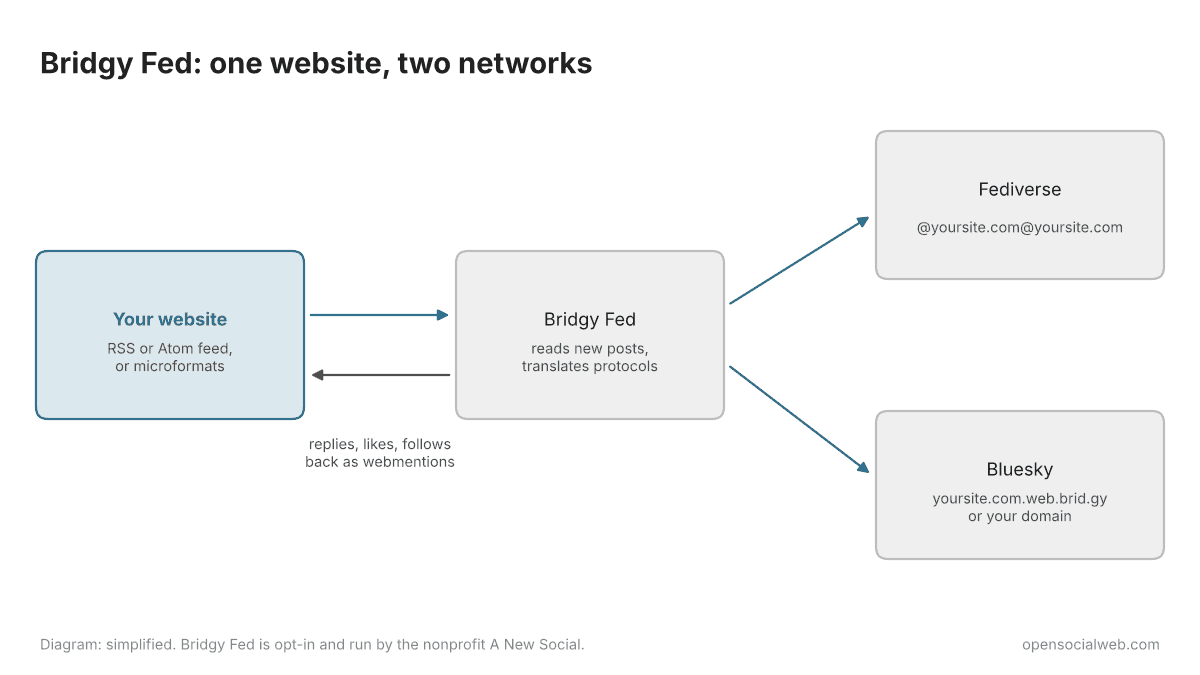
Diagram: Open Social Web, hosted at Pxef.com
What Bridgy Fed needs from the site
One of two things. Either microformats markup plus webmention support, or an RSS or Atom feed that can be found from the home page. Most sites have a feed and no microformats, so the feed route is the common one.
"Found from the home page" means the autodiscovery link in the page head. If a reader can't find your feed by pasting your home page URL, Bridgy Fed can't either. The tag and its pitfalls are covered in RSS Feed Autodiscovery and the Link Tag Every Site Needs.
Once a first follower arrives from the fediverse or Bluesky, Bridgy Fed looks up the feed and from then on checks it periodically for new posts. The docs don't give an interval and don't mention WebSub, so a new post can take a while to show up on the other side.
Which feed fields it uses
Bridgy Fed takes the feed format's own elements: title, URL, author, tags and date. Tags matter more than people expect. RSS <category> and Atom <atom:category> values become hashtags, and hashtags are how people on Mastodon discover posts from accounts they don't follow yet.
<item>
  <title>Hugo RSS Templates That Ship Full Content</title>
  <link>https://example.com/hugo-rss-full-content/</link>
  <pubDate>Mon, 23 Nov 2026 08:00:00 +0000</pubDate>
  <category>Hugo</category>
  <category>RSS</category>
  <description>...</description>
</item>
The bridge includes your full post content when it can and only truncates when it has to. On Mastodon, though, posts that come through as articles show just the title and a link to the full piece. On Bluesky, with its 300-character limit, longer posts are cut and carry an embed linking to the original. Either way the click comes back to your site, which is usually what a publisher wants.
The two-week rule, and why backdating breaks it
Two limits in the docs catch publishers who manage their feeds in bulk.
Bridgy Fed only bridges posts going forward. It doesn't backfill anything published before you enabled it. And it currently skips posts that are more than two weeks old.
So if your workflow sets a post's date in the past, for example to slot a new article evenly into an archive, that post may never reach the fediverse or Bluesky. The same goes for a batch import of old content. If you want a post bridged, give it a current date.
Handles
By default the site's fediverse handle is @[email protected], and its Bluesky handle is yourdomain.com.web.brid.gy. Both can be moved onto your own domain. The fediverse side needs HTTPS and redirects for /.well-known/webfinger and /.well-known/host-meta to Bridgy Fed. The Bluesky side needs a DNS record or a file. The steps for both are laid out in Custom Domain Handles on Bluesky and the Fediverse on Open Social Web.
Replies come back as webmentions
Likes, reposts, replies, mentions and follows arrive at your site as webmentions. A site without a webmention endpoint still gets the reach. It just doesn't see the reactions. A static site can use a hosted webmention service and pull the results in at build time.
One switch to know about: once you send Bridgy Fed any webmention yourself, it stops reading your feed and expects webmentions for every post from then on. Don't experiment with sending webmentions unless you mean to change modes.
Is the feed route worth it
For a site that already publishes a clean feed, it's an afternoon's work for a presence on two networks, tied to your domain. Open Social Web's guide to Bridgy Fed for Websites, Mastodon and Bluesky covers the account side, and POSSE Explained covers the habit behind it: the site stays the original, every network gets a copy that points home. If your site runs WordPress, the ActivityPub plugin makes the site a fediverse account directly, and Bridgy Fed only needs to handle the Bluesky side.